
The key takeaway participating in a CTF challenge is patience and persistence. I attained the 2025 WiCys Security Training Scholarship Tier 1 badge made possible by the SANS Institute and WiCys. The scholarship allowed me to participate in the SANS Cyber Ranges BootUp Capture the Flag (CTF) Tier 1 challenge. Through this CTF event I explored cybersecurity concepts ranging from CyberChef, Wireshark, and basic Kali Linux, to disciplines including digital forensics, cryptography, network analysis, and data analysis.
 CTF are events designed to help you practice and apply real-world cybersecurity skills. Each challenge is more difficult than the next and some build on each other. It’s a great way to translate theories and concepts we learn in academia into the practical realm.
Five lessons-learned during this CTF event:
1. Read Pre-Game Instructions
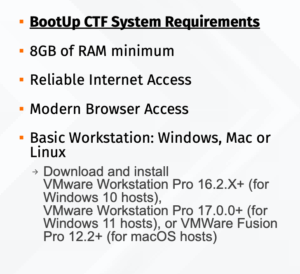
A very simple task but something we usually overlook when getting started. I was so excited to earn the scholarship and start the event that I skimmed over the basic instructions thinking I could dive right in—boy was I wrong. Turns out, there are basic computer requirements that are necessary to have in place to be able to complete certain tasks. For this particular challenge, we needed system requirements such as a RAM minimum, Internet, browser, and a basic workstation. Here is a snapshot:
2. Navigating the VM Rabbithole
A virtual machine (VM) is a simulated environment created by virtualization (National Institute of Standards and Technology, January 2010). What do you do when your old computer shows only 4.9 GB of storage, but you need at least 30 GB to install a virtual machine (VM) for a CTF? For me, it meant three days of deleting and transferring large apps and files just to clear enough space. After much trial and error, here’s how it finally came together:
- Step 1: Cleared storage from 4.9 GB to 32.12 GB (the “magic number” was ~30 GB).
- Step 2: Chose UTM as my VM tool and downloaded Kali Linux.
- Step 3: Realized I had installed the wrong Linux version, deleted it, and re-downloaded the correct x86_64 version.
- Step 4: With the correct setup, UTM + Kali Linux finally installed successfully.
The process was full of headaches, but by pushing through I ended up with a working VM and about 14 GB left to “play with” (a sarcastic but triumphant win given how tight my storage is). That persistence meant I could actually start the challenge, a victory in itself.
3. Just Breathe
Take a moment to step back and breathe before getting into a competitive mode. Yes, breathing is another simple thing some may forget to do these days. These challenges are designed to help you learn. It’s not the end of the world if you fail to find the flag in one challenge. Try the next, capture the flag, and then double-back. Before turning on the computer, I centered myself and breathed. These small positive mindfulness moments helped to focus and have patience when things go awry, and they usually do.
Breathing affects the nervous system, and slow breathing activates the parasympathetic system. Start on the right foot by breathing to reduce any stress or anxiety you may have before tackling the CTF challenges, so that by the end of the day, you have a restful sleep. And remember, the power of positive thinking can shape outcomes, since optimism itself has been shown to improve performance and resilience (Scheier, 1993). So, breathe, breathe, breathe before, during, and after the event, and think that no matter what, you got this.
4. Set Up Your Workstation Cyber Ambiance
Scan your workspace environment and take a moment to set up your cyber ambiance. It’s always ideal to not only prep your computer, but also your surroundings and desk. If your setup is comfy, safe, and secure, you will feel most optimal and ready to tackle the tasks. Add things that make you feel comfortable and focused or don’t add anything at all with a minimalist setup but make the space feel like your own.
For example, you can declutter your desk, add a notebook or digital pad for taking notes, pens, pencils, sticky notes, snacks, and a beverage (preferably water to stay hydrated during long hours of coding). Make sure your outlets are running properly, extension cords plugged in, or laptop batteries charged. You may even want to decorate by adding candles, mood lighting, or music (white noise) to get you in the zone.
Other things to consider, include dressing comfortably, a soft chair, and adding a small pillow for your lower back because it’s all about creature comfort. If working away from home, make sure the place you choose is not too noisy or distracting, and wearing earphones or earplugs to focus.

5. Turn Failure into Growth
How do you deal with failure? For me, badly, but I don’t let it marinate for too long. The outcome does not matter—it’s the journey that counts. You could finish the challenge in first place, last place, or somewhere in the middle. So what? Have you ever noticed in those reality singing shows the winner usually gets a large prize money and contract. Slow clap. But the actual winners wind up being the second, third, fourth, last place, or those that never even make it on to the show. For ex, at just 13 years of age, Lauryn Hill was booed at the Apollo Theater but made history years later winning 8 Grammy Awards (Lauryn Hill, 2015). Well, same scenario just different industry.
Don’t get wrapped up in the results because it’s the journey of persistence and never giving up which count. It’s the lessons that you learn along the way. I didn’t make it past Tier 1, but I learned lots of things during the process that I will be applying to other scenarios. I wasn’t expecting to immediately grasp all the concepts as a social scientist in technical terrain, but slow and steady wins the race. I partook in this event investing time and dedication, stayed until the end, and never gave up—this is winning.
REFERENCES
Hill, Lauryn, “Music Video by Lauryn Hill Performing Who’s Loving You,” Posted November 16, 2015, by Ms. Lauryn Hill, YouTube video, 1 min., 57 sec., https://youtu.be/2nOCW6JL14o?si=_L5qHNukOtJDng-w.
National Institute of Standards and Technology. Guide to Security for Full Virtualization Technologies. NIST Special Publication 800-125. Gaithersburg, MD: U.S. Department of Commerce, January 2010.
Scheier, Michael F., and Charles S. Carver. “On the Power of Positive Thinking: The Benefits of Being Optimistic.” Current Directions in Psychological Science 2, no. 1 (1993): 26–30. http://www.jstor.org/stable/20182190.